


I was mostly but not completely paying attention to a lecture in an introductory ecology class in college one morning when a student sitting next to me asked the professor something about the “fragile balance of nature.” He was sitting on a stool at the front of the class and something shifted in the set of his shoulders, or maybe his jaw, or maybe something even less tangible than that, as shifts are wont to do. He abruptly stood up and slammed his closed fist in his palm, which of course startled all of our spines straight, our sleepy eyes newly animated as we watched him rise up like a preacher to the pulpit. Normally rather self-contained, the man’s energy was suddenly pushing at the seams of the lecture hall. Ecosystems are NOT fragile! He said, his eyes jumping and landing with a thud on each face before moving on to the next one. He raised his hand and pointed at us, his finger scanning the room. If you take nothing else away from this entire course, let it be this: ecosystems are robust! Yes, sometimes they collapse, and mass extinctions wipe out entire species groups. But adaptation is the engine that drives diversity, and diversity is the most resilient ballast in nature. Never, ever insult nature by calling it “fragile.”
I’ll admit that before bearing witness to that passionate outburst, I had, in fact, assumed that the natural balance of things was a rather delicate situation. Hadn’t we humans entered the scene at the eleventh-and-three-quarters-hour and threw everything off kilter? Hadn’t we ruined what had taken billions of years to create, like armed toddlers let loose in the Sistine Chapel? Wasn’t this evidence that the ecosystem’s building blocks were made not of wood or iron, but something more like packed sand? The answer, according to this academically titled man, was “not exactly.” We had changed the planet, in many ways devastatingly and irreversibly, but change is not ruin. Collapse, as it turns out, is often a primordial pivot point. With enough time, new and surprising things always rise from the void— we just might not be around to bear witness to the resurrection. This clarion call: nature is robust! became a persistent, hopeful mantra as I listened to the groan of the ecosystems I loved under the unbearable strain of human greed and carelessness. I would say it until it became a prayer, a silent plea to the robust god of diversity. Please, just let life have the last word.
The call strained to be heard through the clanging bell of my grief when I visited my old home on Catalina Island in 2014 and was faced with the decimation of my beloved kelp forests. Those underwater forests had been my sanctuaries during the years I lived and worked there. The swaying green cathedrals I had hoped to return to in reverent surrender were just…. gone.
I pause here to ask you: where are your sanctuaries? Which places do you return to again and again when you need to regroup and remember who you are? Where do you feel you belong, without having to earn your place? Is it a quiet meadow in the middle of a forest, or a path winding through ancient redwoods? Is there a beach whose warm sands welcome your weary feet? A hill behind your home, or a weeping willow whose familiar branches shelter you from life’s battering storms? If you close your eyes, can you smell the salt or soil or wet moss that saturates the air in that place? And what do you hear? The rising trill of a wild thrush, the distant call of a sharp-winged kite as it tilts towards the horizon, the whisper of a fox or hare moving through dense grass?
For me, those kelp forests, briny and verdant and slippery as wet silk, offered a holy reprieve from the demands of both the external world and also my own internal critic. Submerged in the graceful sway of those towering algae, the sounds of snapping shrimp and flicking fish fins and my own whooshing pulse in my ears, I would return to my body. My eyes would awaken to a world of wonder. Light, in particular, had an almost material quality down there. Dancing golden wands appeared so graspable I often found myself reaching for them. And in their radiant path, scales would shimmer to life and the sea hare nestled fifteen feet below me would transform from an inky back to a vibrant violet-red I can only compare to a velvety rose petal, but even that seems insufficient. Robustness, diversity and adaptation echoed inside that liquid cathedral. It was easy to believe it would always be that healthy.

But when I returned to that place in 2014, just five or six years after I had left it, I did not recognize it. After swimming across the rippled, sandy bay and taking a sharp right at the rocky outcropping we referred to as “the point,” my mind attempted and failed to make sense of the scene laid bare before me. It felt like I had gone on vacation and, upon returning, had driven down my driveway only to look up and find that my house had been removed, with no trace of it having ever been there in the first place. No, not a house. An entire city, gone; every storefront and skyscraper, along with each and every one of its inhabitants. Before me was a wasteland of sand and stone. Silent, still and stale. Lifeless but for one ominous sight: a sprawling barren of rapacious purple sea urchins.
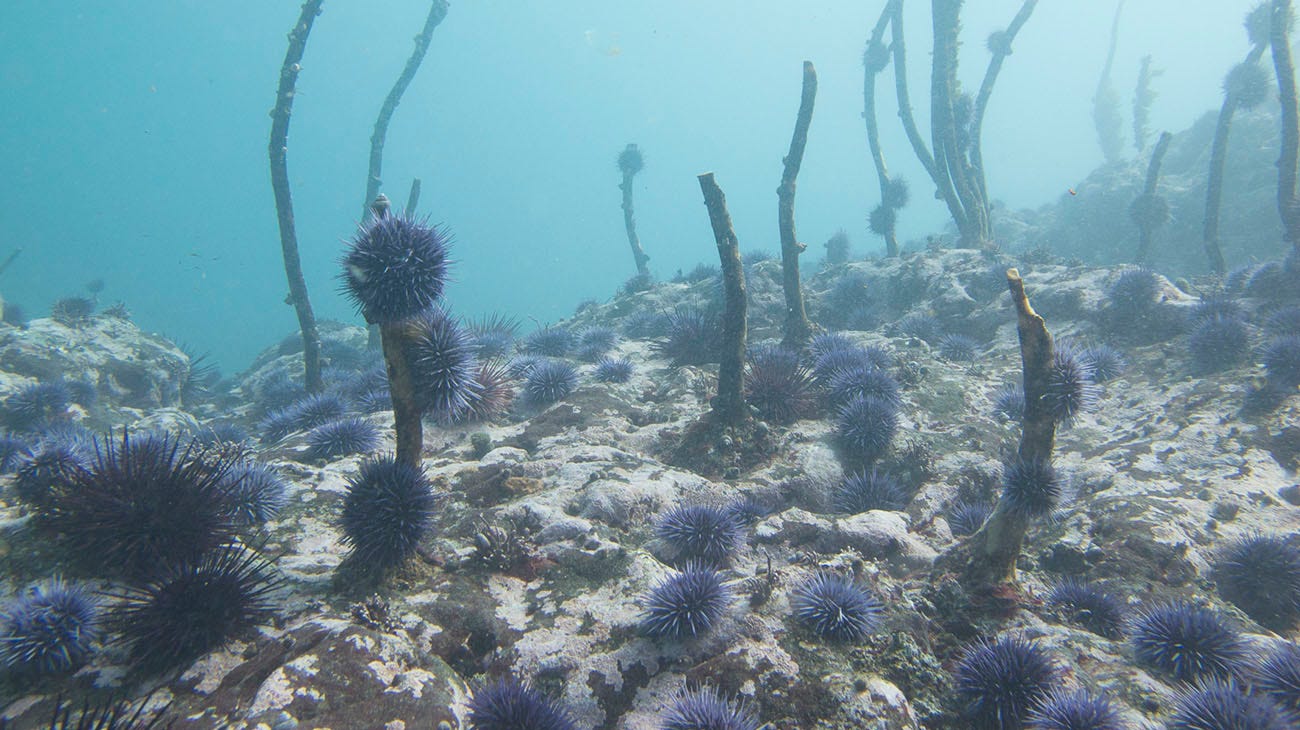
Later, over fish tacos, I found out what had happened from my old boss. He called it “The Blob”— an unseasonably warm ocean current that had swept through Pacific coastal seas beginning in the fall of 2013. There had been a high-pressure ridge in the Gulf of Alaska that had suppressed typical winter storms on the coast, causing the coastal water to warm. It stagnated, preventing surface water from mixing, resulting in an oxygen-depleted current that wreaked havoc on marine ecosystems from Alaska all the way down to Mexico. One of the species that was hit the hardest was the sunflower sea star, Pycnopodia helianthoides, which are very sensitive to oxygen levels in their environment. They developed something called “wasting disease”, which melted their calcium carbonate ossicles (the studded, bony endoskeleton you have felt if you’ve ever touched one) right off their bodies. Their arms turned to pools of goo and fell right off, like something you’d see in a horror film.
The result was catastrophic for the kelp forests. Sea stars are a keystone species in that environment, as the primary predator of the sea urchin. Back in the day, the Channel Islands used to boast a large population of sea otters, which also kept the urchins at bay, but they’d been gone for decades after poachers had obliterated them for their valuable pelts. Alas, when then sea stars melted away in that unnatural heat, the more resilient urchin populations boomed. And what do urchins eat? You guessed it: giant kelp. They gorged themselves, unchecked, until every last frond had been consumed, right down to the roots. And with the protective canopy of the forests gone, everything else left as well. Kelp fish, senorita fish, sheepshead, lobsters, wrasse, garabaldi, eels…. all gone.
The “resilient ballast of diversity” had been knocked out of center, and the ship was rapidly sinking. A once vibrant community had been completely razed by over-consumption. Nature is robust, I reminded myself, but my hopeful tone had given way to desperation.
Sometimes, when I look around the landscape we are living in at this present moment, all I see is sand and stone and barren. The Blob has come, and it has turned all the life-sustaining diversity to a sickly goo. The fat urchins seem to have won, resting contentedly in the spoils of their gluttony. It is impossible not to feel bereft and cripplingly homesick. Where is the beloved community? The golden light? The sounds of life? The shelter? And what is the crucial keystone species missing in the barren moral ecosystem we have found ourselves in?
Surely there are many contributing factors to the collapse; if I know anything at all as a biologist and an attentive observer of the non-material world, it is that both physical and spiritual ecosystems are exceedingly complex. But I can’t stop thinking about the crucial role that narrative has to play in all of this.
We, as a colonizing nation, have been telling a pretty terrible story since the very beginning. A story of manifest destiny and conquest and competition. A story of rugged individualism and domination and violence. A story rotten with racism and exceptionalism and unchecked consumption and expansion.
One of my favorite Christian Celtic mystics, John Phillip Newell, tells a story about a time when he was in the states giving a lecture on the sacredness and divine presence in every person and every creature. Afterward, a Native American elder approached him and said something that struck him deeply:
“If your people had come here expecting to find God in us, history would have been very different.”
What if, instead of assuming that there was an absence of God in this land, those men had come here to humbly receive the stories that the wise native elders had to share? Think about the vastly different origin stories that they used to understand the nature of reality: the Abrahamic “Fall of Adam and Eve” versus the Haudenosaunee “Sky Woman Falling.” These are two extraordinarily different “falls”. The first is hierarchical, centering domination, disobedience, shame, and exile. The second is cooperative, centering interdependence, gratitude, and reciprocity.
One looks an awful lot like the death of interdependence. The other looks like vibrant, communal flourishing.
“So, what do we do about these damn urchins?” I asked my boss, wiping guacamole from my mouth.
“We smash ‘em!” He said, comically wagging his eyebrows over his taco. It sounded pretty satisfying, but I wanted clarification. Why couldn’t they be harvested? What about relocation? How long would it take to wait for the sea stars to rebound? And what do you mean by “smash”, exactly?
He told me that the urchins were starving now that the kelp was gone, but their bodies had entered into a slow metabolic state that they could live in for decades, like zombies, just scraping by on any kelp spore or juvenile that attempted to settle. The fisheries didn’t want them, because they were low in “gonad mass,” which was apparently the tasty part. (“Low gonad zombies": seriously, these metaphors write themselves.)
Ergo, the most effective thing to do was to go freediving with a hammer or a big stick and get smash-happy. He told me they leave all the remains on the seafloor, which eventually get eaten by crabs and other scavengers. Death begets life and all that goodness.
In order to rebuild an ecosystem, sometimes you’ve got to cull the consumers. Once it’s thriving again, the community keeps them in check.
I was raised on the Garden of Eden story, but it’s not one I’ve passed along to my daughter. There are parts that are compelling and truthy- as is the case with all lasting myths- but I don’t have the bandwidth to tell her a story that has been used to shame women for millennia. There’s enough of that in the atmosphere, thank you very much.
Last summer, I was reading Braiding Sweetgrass by Robin Wall Kimmerer, and it was my first introduction to the story of Skywoman. It healed something in me. It felt like the first blade of kelp coming up in the sand, and I could see what beauty could be born from it, if only it was tended to properly. It was as though I had the memory of that particular narrative in my cells, and I was aching for reunion with it.
One evening, I sat my daughter down to tell her this ancient but new-to-me story, and she said, “Oh! I love this story, mama!” I asked her how she knew it, and she told me that her teachers had told it to them one day in the reading tent at her Classroom in Bloom class. This is an outdoor camp she attends in the summer, where the focus is food growth, harvesting and exploration.
“I’ll be Skywoman and show you— hang on!” she said, as she ran to her room to grab some props. She came out with a stuffed parrot, an otter and a sea turtle.
“This is Turtle Island,” she said, tossing the stuffed animal on the ground. “And this,” she said, holding up the otter. “Is the muskrat. He dies for Skywoman.” She said solemnly but matter-of-factly as I nodded in understanding.
She proceeded to jump, or “fall” from the couch, only to be caught by the parrot, who lowered her onto the back of the turtle. Then all the animals gathered to figure out how to help Skywoman make a home, as she was clearly not of the sea, and the muskrat/otter had his tragic moment of glory as he swam to the sea floor to gather some grass for her, drowning in the process. As my daughter cradled his little body, she said, “Look, he has weeds and dirt in his paw.” And she pulled the imaginary elements out and pretended to plant seeds and soil on the back of the turtle. Then she stood up and danced and danced, and I swear I saw her swimming in the swaying kelp forest in my mind’s eye, with the sunlight on her shoulders and all the sea’s inhabitants around her, and I thought, maybe it’s all going to be okay. Maybe life will have the last word in the end.
The kelp forests have returned to Catalina Island, after all. The smashing worked, as well as some help from some folks who bred sunflower stars in captivity and re-released them once the water had cooled again. My professor was right: nature is robust, but there’s nothing wrong with giving it a helping hand from time to time.
Beautifully written. I am solidly in your camp: the stories of individualism and domination must be replaced with stories of community and belonging. I’m thrilled that your daughter is making herself at home as a descendant of Skywoman.
"Change is not ruin. Collapse, as it turns out, is often a primordial pivot point." I was moved by these words, because it feels relevant to so many aspects of life. From the ashes the phoenix rises. From the compost can we fertilize. From the dark night of the soul are we spiritually reborn. Perhaps it is only from the darkness that new life can sprout, and as you say, we may or may not be present to witness the resurrection. But still, it happens. The pivot.