


It seems to me that as the men in power become bloated with the spoils of war and entitlement and domination, women in the public eye (and all around me, even in the small clutch of women waiting to pick up their children from school each day) are, in turn, becoming alarmingly thin. I’m not going to insult you, dear reader, by saying something inane and unhelpful like well, not all women, or not all men. If we were standing on a high ridge, overlooking the charred remains of a forest in the choking wake of a wildfire, and you turned to me with tears streaming down your face and said something to the effect of The trees are all dead, I would not respond by saying Well, not all of them. There’s one over there that seems to have survived. Because you would quite justifiably turn to me with an unamused raised eyebrow and say, Yes, I see that. Thank you, Sherlock. But behold, the wasteland, with a cool sweep of your hand and a heavy sigh.
Anyway, back to the thin women. I am not speaking metaphorically at the moment, much as I love a metaphor. Whatever metaphor does exist will be yours to execute. I mean that they actually appear to be disappearing. In a recent phone conversation with my mom, she mentioned that she had just watched an award show and all the women appeared positively cachectic. I did not know this word, but I nodded anyway, catching her drift, asking her what, exactly, that meant. Oh, you know, it’s like a wasting disease. Terminally sick people get it at the very end of their lives. You can almost see their bones through their skin. She texted me a few photos of some of the afflicted celebrities, and I sat in the carpool lane at my daughters’ school and covered my mouth with my hand, horrified, watching my round-cheeked daughter and her friends playing in the grass with their mud-stained pants and wild, end-of-the-day-hair, wishing I could freeze the moment and watch them unselfconsciously play in their perfect bodies forever.
I am not unfamiliar with very thin bodies flaunted hither and thither, mind you— I was in high school when the hollow-eyed, knobby-kneed Calvin Klein models of the 90s were the aspirational heroine-chic aesthetic. It’s just that the joyful body positivity of the mid 2010s seems to have been vehemently stomped out on the red carpets these days, and no wonder. We can’t have women loving themselves AT ALL SIZES. (Gasp.)
It makes me think that patriarchy is like a tapeworm- it gorges itself while slowly starving its host. (Ok, perhaps I cannot resist a metaphor after all.) Eventually the beautiful, vibrant body it inhabits becomes gaunt and weak and fails to thrive in every conceivable way. It’s untenable; a system entirely out of balance. Just to be clear- this is not about men starving women- they the tapeworm and we the host. And it is not a judgement of individual women choosing to lose weight— that is none of my business. It’s about paying attention to the thing beneath the thing when sweeping cultural trends arise. It is about the system of patriarchy starving the whole body— which is all of us— men and women alike. The result is either frantic binging or controlled deprivation, depending on your expected role in this messed up model. The result is always cachexia.
Later, I was listening to a podcast with Rob Bell and Adam Skolnick while I was cleaning, and they started talking about at the awful things that are transpiring in this global moment, and Rob said this:
I find it fascinating how much power something can have when it’s a millimeter below the surface. So, you think about racism, misogyny— as long as it’s just one click below the surface…. but as soon as it peeps its head up and everyone can see it, when the overlords are doing 40-million-dollar weddings, and when the overlords are like, playing their hand publicly, and it feels like “this is really, really, really, terrible.” It’s actually been happening the whole time, but its exposure and its overreach is generally how those things come crumbling down. 1
Which made me think of Bobbit worms, obviously.
Do you know about Bobbit worms? Imagine an undersea invertebrate that can grow up to about 3 meters long and is a cross between a Demogorgon from Stranger Things and a giant sandworm from Dune. (But also, mesmerizingly rainbow-y. Because nature has a sense of humor like that.)
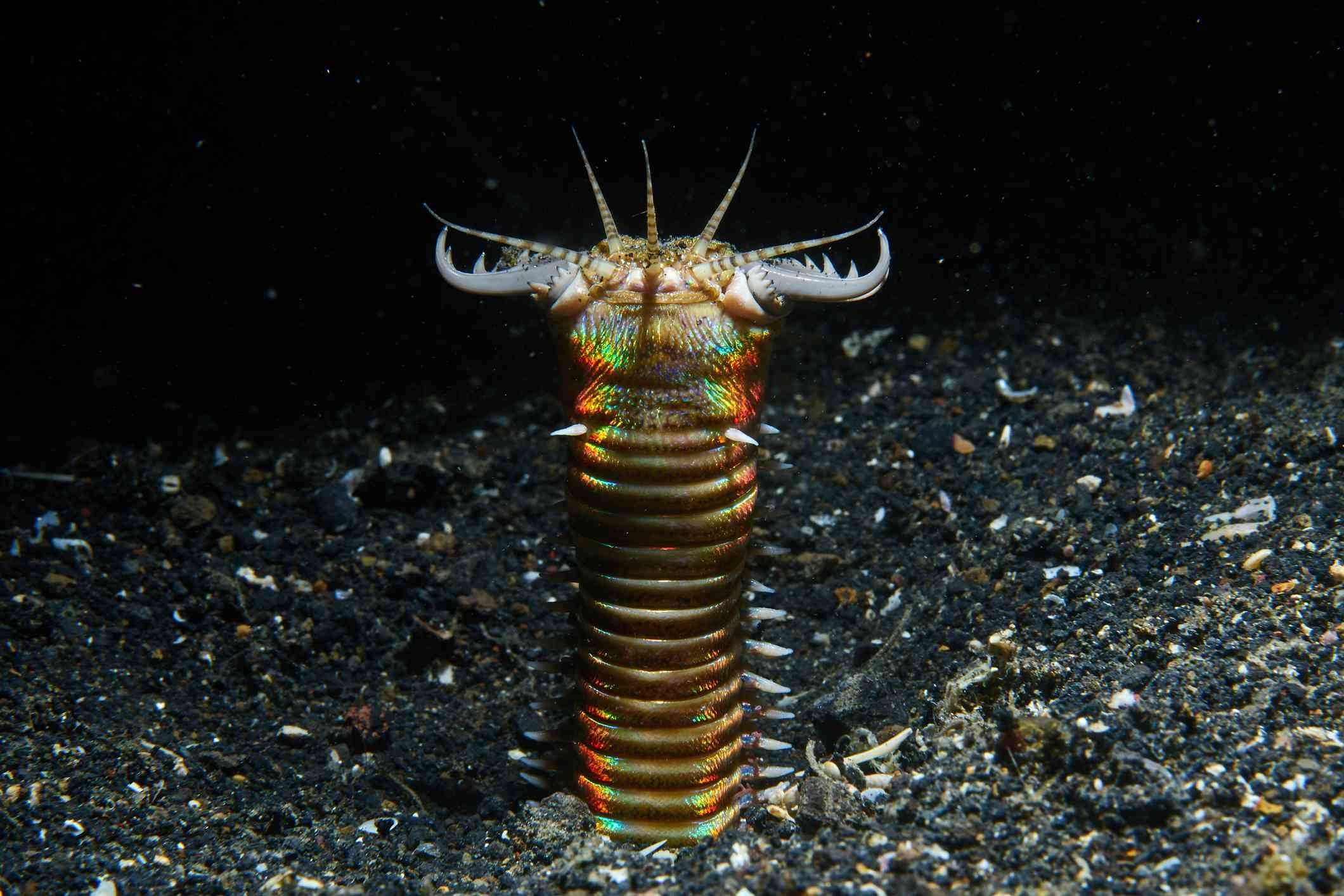
These ancient polychaetae worms are classic nocturnal ambush predators. They create an L-shaped burrow deep under the sand, in quiet areas just outside vibrant coral ecosystems, and at night, they extend hypersensitive tripwire-like antennae above the surface that “taste” the water for incoming prey. When a fish gets close enough to touch their antennae, they lunge upwards, fast as a whipcrack, often severing the fish in half with their powerful mandibles (other times, they drag them into their burrows, still alive, causing the ground to roil and bubble like the lightening sand in the dreaded Fire Swamps in The Princess Bride).2 If you want to watch footage of this, check out the Blue Planet II “Coral Reefs” episode. 3 Honestly, I would encourage you to watch with friends because the dramatic “OOOOOHHHHHHs!” that are involuntarily emitted from the group make it feel like watching a particularly rousing sporting event (but more fun, because there are no actual sports involved.)
The best part of all is that recently, biologists have observed these doe-eyed little Scolopsis affinis fish taking up arms against the monster Bobbit worm. 4 When one of the Scolopsis sees a fellow fish get devoured by the lie-in-wait beast, it swims over its lair and positions itself vertically over the entrance and begins to shoot waterjets from its mouth to expose the Bobbit’s open jaws. Soon, other Scolopsis join in, and the whole group pummels the worm, which has no power at all once revealed, and it rapidly retreats. This is known as “mobbing behavior” in prey, and you may have seen it in your own backyard if you’ve ever witnessed small birds aggressively chasing off hawks or owls, or if you’ve seen footage of meercats brazenly attacking venomous snakes.
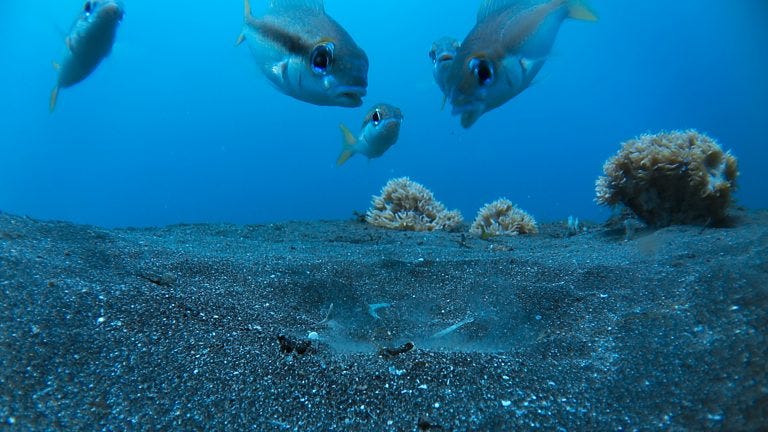
We see you, you memorizing nightmare, you.
Perhaps, then, this is how we defeat the hungry worm: we focus our collective attention on it, refusing to let it sink back down— one dangerous millimeter below the surface— where it will surely become forgotten until it strikes again. We tell stories, remember our history, and blow water jets into the sharp, insatiable jaws in the sand.
Do not despair, my friends. Ambush predators, once exposed, rarely survive very long.
Or so we can hope. And what good are we without our stubborn hope right now?

I shared this poem last summer, but with all this talk of cachexia (and with spring’s hungry blooms just around the corner), I thought now would be a fine time to tidy it up and bring it front and center once again.
Glorious Round Bellies
What happens to a glacier
after it stops moving?
What happens when it becomes so thin
that it no longer has enough weight or
gravity to push its great toe forward?
What happens when it is too
exhausted to do anything but melt?
It has occurred to me (not without remorse)
that nothing in nature wants to be thin
quite as much as I do.
The mother bear keeps teaching her
children where to find buried salmon roe,
their greedy, wet noses dipping
into the water in search of clutches
of honied river pearls.
And in the spring, the caribou
gorge themselves on forbs and
sweet willow shoots, unselfconsciously
flaunting their glorious round bellies
as they glide across the land.
And somewhere, the bony
bar-tailed godwit—after flying for
7,000 miles without resting even once—
descends like a ghost on salty mudflats
to slurp up the soft bodies of crustaceans
until her head is no longer too heavy to lift.
But I, I have forgotten that hunger’s
hollow promise is cruel—
and instead, I insist that my empty belly
is evidence that I am good
and noble and disciplined and worthy.
You know about lifeless things, don’t you?
You know that a motionless body
is doomed to disintegrate,
like the great Okjokull glacier,
now just a whisper of water staring
at the sky like a hollow, unblinking eye,
wondering why it is no longer moved
by its once delicious weight.
But there, just over the hills, the fat buds
of spring are still opening their mouths,
spreading their sweetness without asking
if they are taking up too much space.
And I, I think I will lie down
and let them teach me, once and for all,
how to devour the sun.
And after, when I am heavy with heat,
I will press my ear to the ground, marveling
at the sound of a hungry glacier whose
ponderous, liquid belly is—
at this very moment—
steadily gliding past roots and wings
and other flourishing things.

Bless you if you got that reference. I still have nightmares about Rodents of Unusual Size (R.O.U.S).
Patriarchy starves us all. Yes. Sadly, yes. Let us become the antidote. 🙏
Love this! “The patriarchy is like a tapeworm“ it clearly is eating away at all of us.